Aktualisierte 6 Minuten vor
PPWR-Kennzeichnung für Kaffeeverpackungen: Was gilt jetzt und wie reserviert man Platz für 2028
ypak.coffee
DIE YPAK PACKAGING GROUP wurde gegründet in 2011 und gebildet mit 3 Unternehmen mit Sitz in Hongkong, Dongguan und Foshan. Wir sind zu einem der größten Hersteller von Kaffeesäcken in China geworden. Wir verwenden die besten WIPF-Ventile aus der Schweiz, um Ihren Kaffee frisch zu halten.
Halte dich an die Plastikverbotspolitik ein, die in vielen verschiedenen Ländern verhängt wurde, Wir haben nachhaltige Verpackungstüten erforscht und entwickelt, wie RECYCELBARE und KOMPOSTIERBARE Beutel.
Keine Mindestmenge, Farbplatten sind bei unserem HP 25K INDIGO DIGITALDRUCKSERVICE KEINE FARBPLATTEN ERFORDERLICH..
Sie sind herzlich eingeladen, YPAK zu besuchen.
Für wen ist das: Kaffeemarken, roasters and packaging buyers placing coffee packaging on the EU or Northern Ireland market — whether the packaging is printed in Europe or produced in Asia. If your pouch, carton or sachet carries your brand, the information printed on it is now part of your compliance file, not just your design.
There are two labelling obligations in the EU Packaging and Packaging Waste Regulation (PPWR, Regulierung (WIR) 2025/40), and they do not start on the same date. One is already in force. The other arrives in 2028. Confusing the two is the most expensive mistake in coffee packaging artwork today — not because of fines in the abstract, but because it turns one artwork revision into two.
This article separates the two obligations, shows what must appear on a coffee pack now, then addresses the practical question that matters commercially: how to plan the 2028 harmonised label into the revision you are already making, so the artwork is edited once rather than twice.
Two Label Obligations, Two Dates
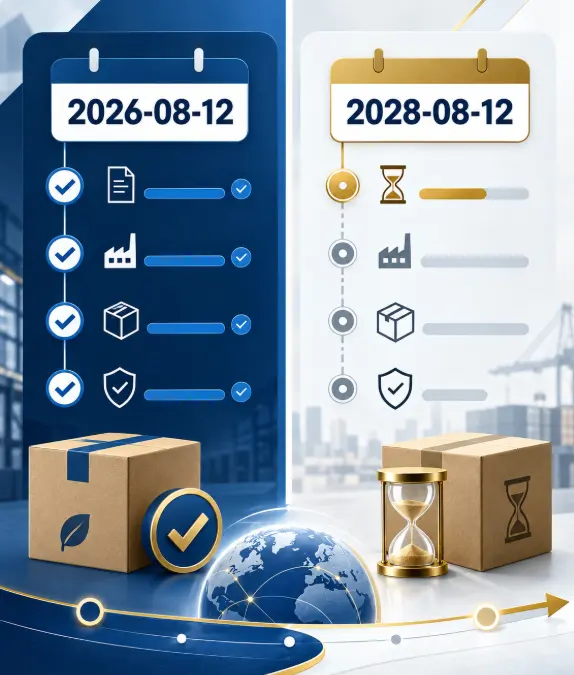
The PPWR spreads its labelling requirements across two timelines, and they serve different purposes: one makes packaging traceable and its responsible operator identifiable; the other tells consumers how to sort it. Both must eventually appear on the same surface area of the same pack.
What already applies from 12 August 2026
Da 12 August 2026, packaging placed on the EU market must carry an identification mark (for example a batch or serial number) together with the responsible operator's name or brand, postal address and a means of electronic contact. In the same wave of obligations, a Declaration of Conformity and its supporting technical documentation must exist for each packaging type, and the PFAS restriction applies to food-contact packaging.
For a coffee brand the practical reading is direct: the artwork you approve this quarter has to contain those identifying elements. Importers verify labelling as part of bringing goods into the EU, which means an artwork gap is discovered at customs or on shelf — not at the design stage where it is cheap to fix.
The exact scope and format of these obligations are governed by the official text and its implementing acts; the summary above reflects current practice for packaging that carries a brand into the EU market.
What arrives on 12 August 2028
Article 12 of the PPWR introduces the harmonised label: a material-composition marking that helps consumers sort packaging correctly, a label for reusable packaging, and a digital identifier (QR-Code). It applies from 12 August 2028, oder 24 months from entry into force of the relevant implementing act, whichever arrangement the official text sets for that element.
This is the second obligation — narrow, graphical and standardised. It is not a replacement for the 2026 identification requirements; it is an addition to the same panel.
Why the two are confused
Because most public discussion of 'PPWR labels' focuses on the 2028 harmonised pictograms, it is easy to conclude that packaging labels are a 2028 topic. Commission guidance issued on 5 Juni 2026 (document C(2026) 3702) clarifies an important structural point: labelling under Article 12 is exhaustive and fully harmonised across the Union, so Member States may not impose additional national mandatory packaging labelling requirements.
Two consequences follow. Erste, you will not have to redesign for country-by-country label variations. Zweitens, and more urgently, the existence of a harmonised system in 2028 does not postpone the identification duties that already apply. The pack in your warehouse has to satisfy today's rules today.
| Obligation | Applies from | What it covers |
| Identification mark and operator details | 12 August 2026 | Batch or serial mark, brand or name, postal address and electronic contact; supported by the Declaration of Conformity and its technical documentation |
| PFAS restriction for food-contact packaging | 12 August 2026 | Restriction on PFAS in food-contact packaging, with defined limit values |
| Harmonised labelling under Article 12 | 12 August 2028 | Material-composition pictogram for sorting, label for reusable packaging and digital identifier (QR) |
What Must Appear on the Pack Now
Stripped to the practical essentials, the elements that packaging must carry today are: an identification mark such as a batch or serial number; the name or brand of the responsible operator; a postal address; and a means of electronic contact, which may be printed as text or carried by a QR code.
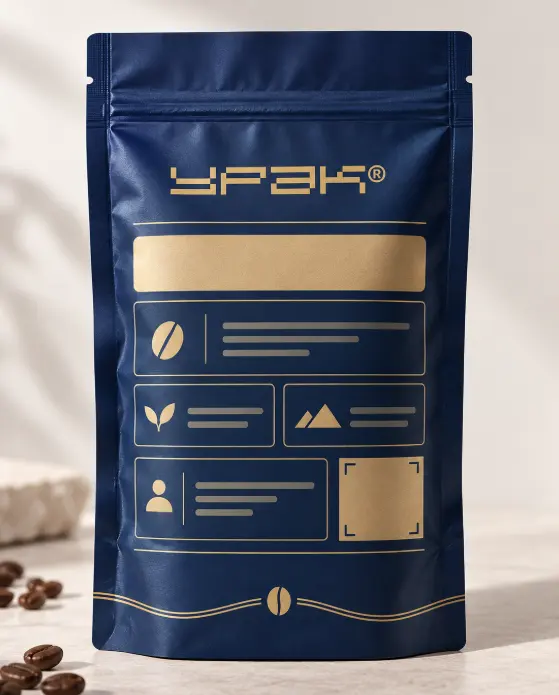
On a coffee pack, the difficulty is rarely the content — it is the competition for space. A back panel that already carries brewing guidance, storage advice, origin information and certification marks now has to accommodate identifying data that cannot be treated as optional detail. The design task is therefore a hierarchy task: which information is legally required, which is commercially valuable, and which is decorative.
Responsibility also needs to be assigned before artwork goes to print. The operator placing the packaging on the EU market carries the Declaration of Conformity and the operator details on the pack; a non-EU manufacturer supplies the technical data that supports them. Artwork that names the wrong entity is not a branding question — it is a compliance one.
Where It Must Fit: Printable Area by Coffee Pack Format
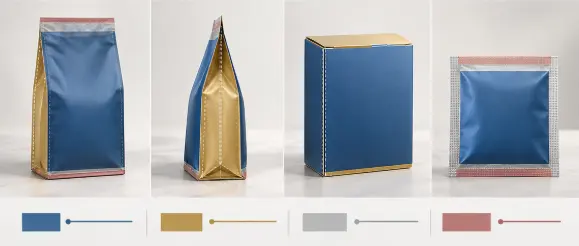
Coffee packaging is unusually varied, and the same information block behaves differently on each format. Four cases cover most of the category:
- Flachbodenbeutel: the largest clean back panel in common use, best suited to a consolidated information block. The base fold is not usable area, and the bottom gusset should not carry critical data.
- Side gusset pouch: the gusset is discontinuous once the pack is filled, so information should not be laid across it. A split layout — identity on the flat panel, supporting detail on the gusset — is usually more reliable.
- Faltkarton: multiple panels allow information to be separated by function, which helps with cartons that must also carry compatibility or product details. Seams and score lines remain no-go areas for identification marks.
- Drip bags, sachets and capsule cartons: individual units are too small to carry everything, so the outer carton usually carries the identification data. On capsule cartons, regulatory identification must coexist with machine-compatibility information, which is why panel planning matters more than font reduction.
Two physical constraints recur. Erste, curvature: on a filled pouch, the surface is not flat, and a code placed on a curved or flexing area can lose print quality exactly where it must remain scannable. Zweitens, seal areas: heat-sealed zones deform and should never carry required information.
On minimum sizes and font dimensions, the position remains that technical specifications such as font size or pictogram dimensions are not yet fixed and will be set in separate implementing acts. The dimensional guidance we apply internally — for example keeping identification blocks to a sensible minimum and checking contrast against the print method — is practical advice, not a legal standard.
Get the Material Identification Code Right
Material identification codes sit in the same visual territory as the 2028 harmonised label and are frequently applied incorrectly. The code system established by Commission Decision 97/129/EC uses letter abbreviations for material families — for example the PAP series for paper-based packaging and C/ combinations where a pack combines materials.
| Typical coffee pack structure | What the pack is | Marking logic | Common error |
| Paper-based carton (unglued to plastic) | Single material family | PAP series markings | Using a generic recycling symbol instead of a material code |
| Pouch with paper outer layer plus plastic barrier | Composite (multi-material) | Composite marking reflecting the combination | Marking it as pure paper because the outer surface looks like paper |
| Pouch with aluminium layer | Composite with metal | Composite marking reflecting the combination | Using a paper code to keep the 'recyclable' story simple |
| Stand-up pouch with valve and zipper | Composite plus components | Body marking by material; components considered separately | Treating valve or zipper as part of a single 'paper' pack |
The error that matters most commercially is the second row: a pack that reads as paper on the outside but contains a plastic or aluminium barrier. When the marking says paper and the structure is composite, sorting systems are given false information, and the packaging's own documentation no longer matches what is physically on the shelf. Inaccurate identification is not a detail to be resolved later; it is exactly the kind of mismatch market surveillance looks for.
The practical rule we use with customers is straightforward: choose the code from the structure specification, never from the surface appearance or the marketing description. Where a pack genuinely combines materials, plan panel space for the components rather than compressing everything into one mark.
Reserve for 2028 in This Year's Revision
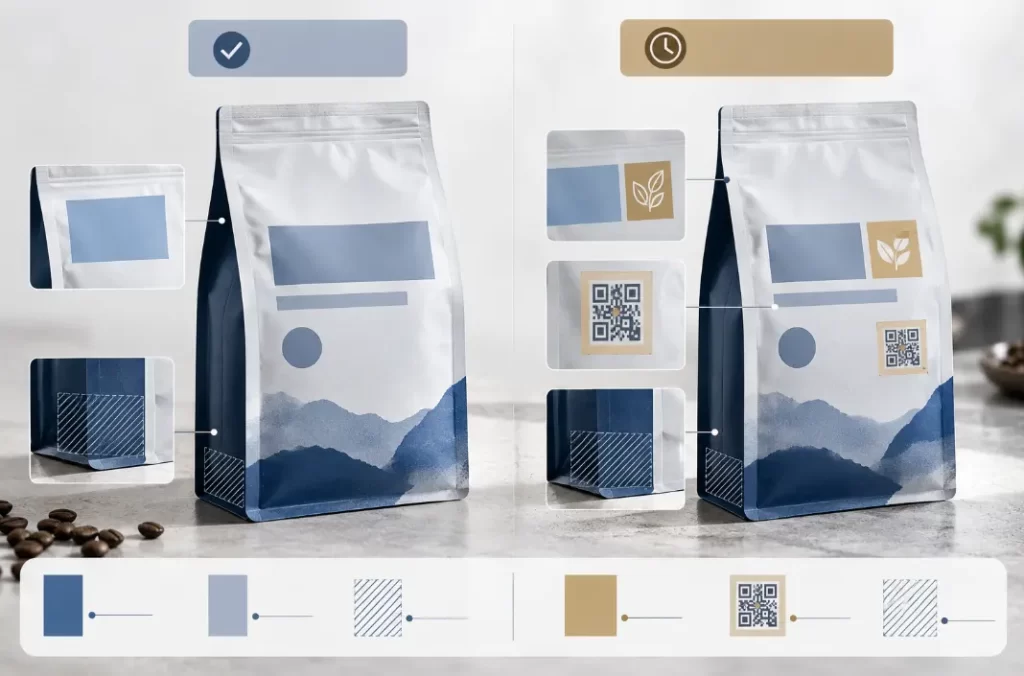
This is where the commercial argument sits. If you revise artwork now only to satisfy the 2026 identification duties, and then revise again for the harmonised label in 2028, you pay twice: two artwork approvals, two proof cycles, two print implementations, and a second round of stock transition. If you plan the space now, the second change becomes a fill-in rather than a redesign.
Three reservations are worth building into the current revision:
- A defined block for the material-composition pictogram — a stable geometric area that can accept a standardised marking without crowding adjacent brand elements.
- A dedicated QR area, placed on a flat, non-flexing part of the pack so it stays scannable after filling. Do not place it across a gusset, seal or curvature point.
- A marking area for reusable packaging, if your range has any reusable component in development, so the pack does not need a third revision later.
The economics of the second change depend heavily on the printing method. Under rotogravure, artwork changes are tied to cylinder work, which is why batching changes is standard practice. Under digital printing, there is no plate or cylinder cost, so the marginal cost of a version change is largely documentation, approval and inventory coordination. Either way, the decision that saves money is made at the artwork stage, not at the reprint stage.
We also recommend starting a simple label version table with this revision: which artwork version carries which identification logic, on which pack format, for which market. It takes an hour to create and prevents the most common failure we see — a compliant design shipping with artwork from two revisions earlier.
Batch-Codes, Traceability and the Declaration of Conformity
The identification mark on the pack is not free text. It connects the physical package to the declaration and technical documentation that must exist for each packaging type, which is why the batch logic deserves a decision rather than a default.
Two points are worth stating clearly for planning purposes. Erste, a change of print design alone generally does not require a new Declaration of Conformity, whereas a change of material or packaging format does — so artwork edits made for labelling reasons should be logged against the existing declaration rather than treated as a trigger for a new one. Zweitens, when the batch or identification logic does change, the documentation has to move with it; a file that no longer describes the pack in circulation is itself a compliance problem.
In practice this means agreeing a batch coding rule (for example production date, line and sequence) with your supplier, printing it consistently, and recording it in the artwork specification — so that a reviewer, an importer or a customs officer can connect the pack in hand to the file behind it.
A Pre-Print Audit Checklist
Before an artwork file is released to print, these six checks catch almost every labelling issue we encounter in coffee packaging:
- Are the required identifying elements present, and legible at final print size on the actual substrate?
- Does the material identification code match the real structure, including any barrier layer, valve or window?
- Does any critical information cross a fold, gusset, seal zone or curvature point?
- Is the electronic contact element — QR or printed detail — functional at the size and contrast actually printed?
- Is space reserved for the 2028 harmonised marking and digital identifier?
- Does the batch and identification logic match the technical documentation that supports the declaration?
How YPAK Supports This Stage
Als Hersteller, we sit upstream of the declaration but deep inside the artwork. Three supports are relevant here:
- Pre-print artwork audit: we check an existing or draft print file against the checklist above and return a gap list — panel by panel, format by format.
- Material marking review: we verify the identification code against the actual structure specification, including composite constructions, so the code on the pack and the structure in the technical file agree.
- Version and print planning: for ranges with multiple origins, roast levels or seasonal releases, we plan version sets so that identification data and 2028 reservations are consistent across SKUs, using digital printing where short runs and frequent version changes would otherwise be costly.
If you are preparing an EU-bound launch or revisiting existing artwork, our packaging compliance health check reviews the labelling layer alongside the design and documentation layers, so the three are decided in one pass rather than three.
Schlussfolgerung
Labelling is not the last item on a packaging project; it is the item that decides whether the artwork can be released. The duties that apply now concern identity and traceability, and they are already live. The harmonised label that arrives in 2028 concerns sorting and reuse, and its space can be planned today.
Treating the two as one revision is the cheapest route available: one approval cycle, one print implementation, one version table. The alternative — waiting until the pictograms are mandatory — means paying for a redesign that could have been a reservation.
Quellen & Disclaimer
1. Regulierung (WIR) 2025/40 (PPWR, including Article 12 on labelling): https://eur-lex.europa.eu/eli/reg/2025/40/oj/eng
2. European Commission guidance document C(2026) 3702 on packaging labelling (5 Juni 2026): https://eur-lex.europa.eu/legal-content/EN/TXT/PDF/?uri=PI_COM:C(2026)3702
3. Commission Decision 97/129/EC on material identification codes for packaging: available via EUR-Lex (CELEX 31997D0129).
4. European Commission — Packaging waste: https://environment.ec.europa.eu/topics/circular-economy-topics/packaging-waste_en
Rechtlicher Haftungsausschluss: Dieser Artikel enthält allgemeine Informationen und Brancheninterpretationen; es stellt keine Rechtsberatung dar. Rechtliche Bestimmungen, thresholds, dates and enforcement practice depend on the official texts and the authorities of the EU and its member states. Für spezifische Compliance-Entscheidungen, Konsultieren Sie einen qualifizierten Rechtsberater.
FAQ: PPWR-Kennzeichnung für Kaffeeverpackungen
Geschrieben von
ypak.coffee
ypak
DIE YPAK PACKAGING GROUP wurde gegründet in 2011 und gebildet mit 3 Unternehmen mit Sitz in Hongkong, Dongguan und Foshan. Wir sind zu einem der größten Hersteller von Kaffeesäcken in China geworden. Wir verwenden die besten WIPF-Ventile aus der Schweiz, um Ihren Kaffee frisch zu halten.
Halte dich an die Plastikverbotspolitik ein, die in vielen verschiedenen Ländern verhängt wurde, Wir haben nachhaltige Verpackungstüten erforscht und entwickelt, wie RECYCELBARE und KOMPOSTIERBARE Beutel.
Keine Mindestmenge, Farbplatten sind bei unserem HP 25K INDIGO DIGITALDRUCKSERVICE KEINE FARBPLATTEN ERFORDERLICH..
Sie sind herzlich eingeladen, YPAK zu besuchen.
Verwandte Artikel
PPWR-Kennzeichnung für Kaffeeverpackungen: Was gilt jetzt und wie reserviert man Platz für 2028
Custom Coffee Packaging Bags Wholesale: Ein Käuferleitfaden
Individuell bedruckte Boxen: Vom Design der Kaffeeverpackungen bis zur Produktion